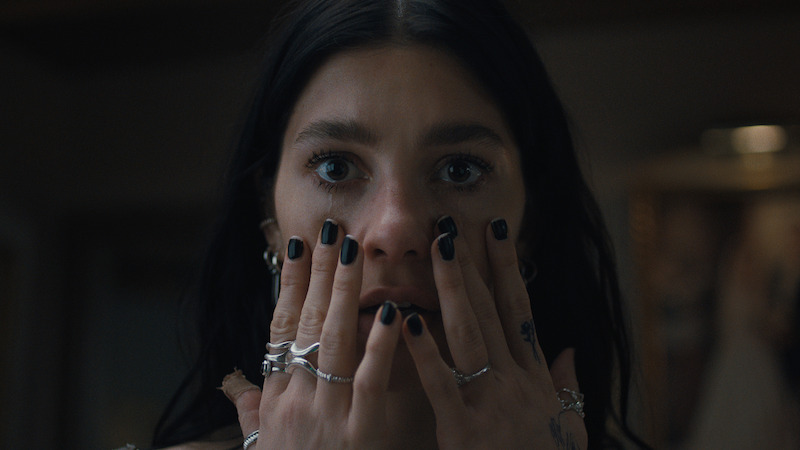
Directors: Weronika Tofilska, Axelle Carolyn & Lisa Brühlmann
Running Time: 371 minutes
Rating: 3 🌟 1/2
Here’s a hypothetical scenario: something very bad is going to happen if you marry your partner and they’re not your soulmate. Are you still sure they’re the one?
Description
Something Very Bad Is Going to Happen (2026) is a miniseries created by Haley Z. Boston and showcased on Netflix. It follows Rachel, who is engaged to the love of her life, Nicky in the lead-up to their perfect wedding. At least it should be perfect but nothing’s ever simple where love’s concerned, is it?
On their way to Nicky’s family home for the wedding, Rachel meets a mysterious character in a dive bar. He warns her that her fiancé might not be who she thinks he is. She believes he’s just another creep and quickly escapes. Once they arrive though, strange things keep happening and she realises there might be more to the strange man’s warning than she initially thought.
How do you know if the person you love is your ‘soulmate’? Is it worth taking the risk for a marriage certificate? Something Very Bad Is Going to Happen explores these themes in a fun, unsettling way.
At the beginning of this miniseries, I was glued to my screen. The suspense was strong, especially with the ‘abandoned’ baby in the car and the strange man in the bar. There was potential for any number of storylines to present themselves and I had fun trying to guess what was going to happen. However, as the show progressed, it became loose and lost its momentum. What was intriguing quickly became predictable and I believe that’s because of its length. It felt as though a solid screenplay had to have extras added to it because it needed to be longer. Largely filler and less killer and while I enjoyed the ending, I could see why many others didn’t.
Nicky’s family was extremely intense, creating some excellent, folkloric scenes. Gus Birney was particularly good as Portia and I know that because I wanted her to be quiet every time she was in a scene. The combination of overbearing and demanding makes you side with Rachel as soon as they arrive at the house and it only gets worse from there.
It is Portia who tells Rachel the story of the ‘Sorry Man’, a mysterious figure her older brother Jules saw when he was a child. According to Jules, he was exploring one day when he entered a house. When the owners of the house returned, he found himself trapped hiding under the bed. What follows was a bloodbath, one that he has never forgotten. The ‘Sorry Man’ becomes a haunting figure throughout the story with the sad explanation being revealed in one of the later episodes.
“Never marry a momma’s boy” or however the advice goes. Image Source: Marie Clare
One of the strongest aspects of the series is the use of lighting and colours to explore theming. The neon lights and blue dingy tinge of the dive bar. The stark white of snow against concentrated blood red. Often in horror films and shows, everything is extremely dark and one-dimensional but the visuals of Something Very Bad Is Going to Happen are something different.
There were parts of the story that didn’t make any sense even to someone willing to suspend their disbelief. At one point, Rachel and Nell break into the records office to find marital information on Rachel’s ancestors. It seems unlikely they would manage to get in so easily, and unchallenged, whether it was a day off or not. Plus, it was far too convenient for me that all the records were simply there. I’ve personally had difficulty getting archived information about a relative one generation above.
Initially, I thought the show was going to take itself too seriously but it became the perfect mix of comedy and horror. Nell and Jules’ bizarre relationship dynamic added both tension and comic relief. Nell was certainly one of the best characters.
There’s nothing like true love. Image Source: The Playlist
Recommendation or Regret?
Despite feeling overinflated in the middle and the existence of several plot holes and flaws, I would still recommend this series if you’re a horror fan. The atmosphere was spooky but simultaneously a little fun, never taking itself too seriously. Marriage is an institution that many people still put all their faith in and it was interesting to see the creators explore an alternative message.
If you’re in the mood to read more horror reviews, check out this Junji Ito double bill.
As someone who writes about film, I try to watch examples from as many countries, movements and directors as possible to diversify my viewing. From new releases to the origins of film, I love dabbling in various eras to see what resonates with me and what has influenced the medium. When I was studying film, the French New Wave was one of the most popular units because of films like the ones featured below.
This is a list of five French New Wave films you can watch as a beginner to begin to understand the movement. Of course, you don’t have to start here but I found these films accessible and I still enjoy revisiting them today.
One of my French New Wave favourites. Image Source: The Indiependent
Cléo de 5 à 7 (1962) directed by Agnès Varda was the first film from the French New Wave I watched. It was when I was studying Film and I remember thinking it was the best film I’d ever seen at the time. During the film, we follow Cléo who is awaiting important hospital test results. We see her becoming increasingly tense as she conducts her daily rituals but eventually she escapes to the park for some time on her own.
At the park she meets a man who is leaving for the Algerian Revolution that same evening. Together, they share their anxieties and get to know one another. The Algerian Revolution and the emotions surrounding it is a common theme for many films emanating from the French New Wave. This film especially correlates the precarity of time relating to health and war. It’s ideal for a beginner because it’s ripe with symbolism that can be endlessly analysed by the budding film enthusiast.
Many of the representations of women you can see in French New Wave cinema are through the male gaze. Particularly in films from ‘right bank’ directors, women are not afforded quite as much autonomy as their male counterparts. Agnès Varda, on the other hand, portrays women and their endless complexities wonderfully. This is why I have to say she is probably my favourite of the French New Wave directors.
2. À bout de souffle (1960)
I’d be breathless too if I smoked that many cigarettes. Image Source: Movie Musings
À bout de souffle (1960) or Breathless is probably on every Film Studies curriculum and ‘best ever’ list. It is the film many people think of first when the topic of French New Wave comes up. Although it’s not my favourite on this list, I think it’s an ideal place for beginners to start to situate themselves in the movement.
In the film, we get an intimate look into the relationship between an American woman, Patricia, and French criminal, Michel. Michel is on the run from the law after he impulsively committed a serious crime. However, this doesn’t stop him from taking his time to catch up on Philosophy and love.
The ending to this film is iconic and one I come back to again and again. Jean-Luc Godard was one of the editors of the Cahiers du cinema and he believed directors are the ‘authors’ of film (where the term auteur originates from). As such, his films became, and have remained, highly influential across the globe.
Jules et Jim (1962) is another entry from the French Film Wave catalogue that I watched early in my film journey. As such, I know it’s a tried and true option for beginners. Jules et Jim walked so films like Guadagnino’s Challengers (2024) could run, although in my opinion, the former will always be the better option for weird love triangles.
The film follows two friends, Jules and Jim in their respective relationships with Catherine. Not quite a throuple, there are nonetheless complicated feelings that exist within the trio which ultimately ends in a tragedy.
Complicated relationships are also often featured in French New Wave films and I feel it would be difficult to get much more complicated than the relationships that exist between the three characters in Jules et Jim. If complex character studies are your preference, I would strongly suggest starting here.
4. Les parapluies de Cherbourg (1964)
Inspiration for films like La La Land (2016). Image Source: 150 Word Reviews
Recently, I watched both In the Mood for Love (2000) and Past Lives (2023) and I can only imagine Wong Kar-wai and Celine Song were inspired by Jacques Demy’s The Umbrellas of Cherbourg (1964).
The film follows Geneviève and Guy as they fall in love and talk about marriage. Before they can tie the knot, Guy is drafted to fight in the Algerian Revolution and while he’s away, Geneviève receives an offer that leads to their separation.
The saturated colours seep across scenes as a feast for the eyes. Simultaneously, we have intense themes of war, love and loss being explored through song. At the beginning, one of Guy’s colleagues says they prefer movies over the opera but with this film, you’re essentially receiving the best of both.
Unlike the four other films on this list, La jetée (1962) is a short film at only twenty-nine minutes. It also strays from the typical slice-of-life tendencies of other French New Wave films.
The film follows a man in a post-apocalyptic Paris that is reeling following World War II. Scientists are trying to find someone who can bear the mental toll of time travel and it seems this man is the candidate they’re looking for.
During his time in the past, he meets a woman. Later, when he realises he is to be executed, he asks the future scientists to return him to this past in hopes he can find her again. It is a complex short that questions temporality, permanence and science.
It’s not necessarily the easiest of this bunch to understand but I would still consider it a film for beginners.
Those are five French New Wave films for beginners. If you’d like to request anymore articles or reviews from this movement, please let me know in the comments.
Thrash (2026) is another shark film that imagines what might happen if bull sharks were to swim into cities during catastrophic storm surges. Lisa, a pregnant woman who has recently been left by her fiancé, is stuck in Annieville when she is forced to go to work despite evacuation warnings.
When a fallen tree traps her in her car with waters rapidly rising, she must rely on other people who have become stuck in place. However, there are complications. Big, brash, bull shark style complications. The group, including agoraphobic Dakota, her marine biologist uncle Dale and a group of foster children must traverse the trials and tribulations of climate change and their new friends in the water.
Will the group survive or will it be a bull shark bloodbath?
Shark films have really gone off in a direction of their own and Thrash (2026) is the abysmal result. There are many reviews accusing the crew of using ChatGPT to write this film. This reflects the limited creativity involved in its production. Rather than new ideas that take the genre into alternative directions, we have your usual ‘oh no, sharks are here now for some reason’ plot and subpar acting.
Phoebe Dynevor was flying high following her Bridgerton (2020) debut but choosing projects like Thrash surely cannot be helping her portfolio. Although her story is emotional, her one-dimensional acting and dodgy American accent strip it of any and all feeling outside second-hand embarrassment. Whitney Peak’s performance was better but speaking from a former agoraphobe, I can’t say the portrayal of the condition was particularly accurate (in my case).
For a shark film, there was hardly any shark screen time. Occasionally we’d see a fin slice through the water and a pool of blood emerge. My favourite part was when Billy Olsen’s butt cheek is bitten off before he ends up unintentionally sacrificing himself to save the foster children he has made miserable for their entire time together. Furthermore, Dale introduces us to Nellie, the Great White, but her relevance to the story isn’t really discussed. It seems she’s there to wrap things up neatly at the end so our protagonists don’t get chomped in half.
The ending is a large part of the problem with this film. The pacing throughout isn’t perfect but it’s acceptable until the ending. Within the last fifteen or so minutes, we’ve got a newborn baby, Dale conveniently arriving with the boat and Nellie having a light snack of bull shark. It feels way too rushed.
I do get the feeling that the creators were intentionally messing with us. That birth playlist for example? I fear listening to A Thousand Miles while giving birth is punishable by shark. Even the title seems to be parodying itself – the title of this post was only too easy for me to come up with. Is the film one big satire or did we just witness another shark film failure?
Agoraphobia vs shark is a Sophie’s Choice situation if we’ve ever heard one. Image Source: Giant Freakin Robot
Recommendation or Regret
I have to say, I was having fun with the film for a good while. The plot was unrealistic, the acting was goofy and the runtime passed quickly without me realising. But, can I say it was a good film? Absolutely not.
Although I don’t necessarily regret watching it myself, I can’t recommend it in good faith. We’ve seen shark film after shark film now. I think it’s time to expand into films about different creatures. What about a film about barnacles? That would be much grosser, in my opinion.
Ready to read about another 2026 release? Check out the review for adventure thriller, Apex.
Black Narcissus (1947) poster. Image Source: Wikipedia.
People
The most striking issues with Black Narcissus (1947) are the constant references to the local people as ‘primitive’. People have used words like ‘savage’ since the dawn of colonisation to justify the barbaric methods of displacement and oppression utilised by colonising countries. According to the Dictionary of Race, Ethnicity and Culture (2003), the word ‘primitive’ has replaced the word ‘savage’ but still has ‘derogatory connotations’ (pp.231-232).
Shortly after they arrive, the sisters pay people to attend the school and dispensary they’ve set up. As the schoolroom becomes crowded with children, Sister Ruth says, ‘what can you do with them? They look very stupid to me. Remember, they can’t speak a word of Hindustani or English’ (Black Narcissus, 1947). The way Sister Ruth correlates stupidity with an inability to speak the languages the sisters speak belies the attitude that colonised people should speak the language of their colonisers.
Prior to colonising countries all over the world, English was only spoken in Britain (Simon and Simon, 2023). However, as a result of English schooling, the language came to be associated with education, and according to Migge and Léglise (2007), the ‘linguistic decolonisation of both European and non-European cultures is hardly complete’ (p.1). This highlights the lasting effect attitudes like Sister Ruth’s have had on global cultures and languages.
One of the main characters on the receiving end of the convent’s overt racism and classism is Kanchi. Sister Clodagh judges for her open sexuality and Ayah beats her for stealing a ‘brass chain from the church room to put around her dirty neck’ (Black Narcissus, 1947). People expect this sexuality from the Indian teenager, but assume the white nuns are ill or mad when they display any hint of sexuality.
However positive you may feel about the innovation in terms of the filming of Black Narcissus, you cannot deny the frequent use of brownface is distracting. Despite managing to cast Indian actor Sabu in the role of Dilip Rai, apparently no other Indian actors could make the casting and instead, we have white people in brownface for several of the main characters, including Toda Rai, Ayah and Kanchi. Guy Aoki (2015) explains that ‘having white actors play other races, often in ways that mock, is as old as the film industry itself’ and ‘racism is certainly a factor contributing to the casting of white people to play other races’.
This seems to be the case for Black Narcissus. For example, in one scene, Sister Ruth responds that ‘they all look alike to me’ when told the people are not black. This is a shocking admission that makes the entire viewing uncomfortable today.
Place
Approximately five minutes into the film, Mr. Dean describes Mopu to the sisters at the convent in his letter. He explains that it is in ‘the back of beyond’ and the palace is ‘called a palace but there may be a slight difference between your idea of a palace and the general’s’ (Black Narcissus, 1947). This condescending description further serves to other the community in Mopu and emphasise the supposed superiority of the British in the final years of their rule over India.
The entire film is shot at Pinewood Studios and in West Sussex in a private gardens with the appropriate types of plants. The crew didn’t film any of the scenes on location in the Himalayas. This is a creative feat by the cinematographer, Jack Cardiff and art director, Alfred Junge. Although by today’s standards, the use of matte paintings and miniatures is glaringly obvious, the ability to transport the audience to India using these methods was extremely innovative and exciting at the time. The creative duo reportedly took Technicolor to ‘delirious new heights’ by creating ‘an otherworldly atmosphere that reflects the psychological arc of the film’s characters’ (Criterion, 2018).
On the other hand, this filming off location paired with the rampant racism displayed throughout suggest further categorisation of India and its people as other. The concept of filming something set in a remote, mountainous location in a studio in Buckinghamshire is one that is distancing, firmly placing the Indian characters as being ‘over there’ and the British ones, especially at the end when their mission has failed, as ‘over here’.
Another scene in the film emphasises difference between the sisters’ experiences at home and their experiences in the palace. Sister Bryony suggests something ‘unhealthy in the water’ is causing the women’s spots. Mr. Dean quickly rebukes this but the insinuation that Britain is clean and India is dirty still remains – another attitude firmly rooted in colonisation.
Religion
The holy man lives on the mountain, seemingly never moving, even to eat. The local people mythologise him, bring him offerings and in general, he offers comfort and a source of pride. However, Sister Clodagh does not replicate this respect. She focuses more closely on property boundaries and asks Mr. Dean if he can be relocated somewhere else. This shines a light on Christian attempts to displace local religions and pedestalise their own as the predominant religion in the respective region.
Sister Clodagh’s question of the general ‘turning out’ his uncle, the holy man, is an imperialist attitude – instead of respecting him in the same way as the locals do or simply leaving him alone to continue doing what he has done for a long time, she wants to forcibly remove him. This could suggest she is uncomfortable with any ‘competition’ in the religious sphere, believing as she does in Jesus Christ and God. We can also see this in the battle between the horns and drums in the village and the bells of the palace. The former are unfamiliar to the sisters so they attempt to drown them out with the ringing of the bells.
Sexuality
The palace at Mopu previously housed the general’s harem and you can see evidence of this in some of the images dotted around the building. There is a clear juxtaposition between the sexualised Indian women and the ‘pure’ nuns in their symbolic white attire. This distinction is again showing popular and derogatory stereotypes of the period.
However, as the film progresses, we see that Sister Clodagh was previously in a relationship with a man whom she believed she was going to marry. These flashbacks are often interspersed with images of Clodagh in the present with a smile on her face. She evidently has fond memories of this time in her life despite the unfortunate ending and we see a new side to her that audiences wouldn’t necessarily associate with a nun.
Mr. Dean acts as the great temptation and we see flirtations between him and Sister Clodagh despite the latter’s loyalty to the convent and vows to God. Sister Ruth’s religious dedication also unravels but to a greater degree as she becomes obsessed with the attractive caretaker. We see her become more visually dishevelled, with her facial features becoming more distorted and sinister. She develops red rings around her eyes, hinting at a mixture of sleeplessness and psychosis. Similarly, when she resigns from her position as a sister, she dresses in a red dress with bright, red lipstick. This highlights her burgeoning sexuality in pursuit of Mr. Dean. It also evinces the increasing danger she poses to herself and those around her.
While the Indian women, particularly Kanchi and those depicted in the murals are chastised and judged for their open sexuality, Sister Ruth is portrayed as being mad or ill. These are usually temporary states, suggesting this sexuality is not in Ruth’s nature as a white woman. Sister Clodagh represents abstinence in the face of temptation, as she leaves Mr. Dean to work in a different convent despite clearly harbouring some feelings for him.
It seems strange and discomfiting that these white women yearning for Mr. Dean is set against a backdrop of open racism. While it is recognisable that Black Narcissus contributed a great deal to the cinematic landscape, the handling of the subject matter is regularly uncomfortable and distracting.
If you’d like more film essays, read about disfigurement and spectacle in Georges Franju’s Eyes Without a Face.
Last month, I began to enjoy films again and I’m now excited to watch as many as I can for the rest of the year. In recent years, I’ve struggled to watch as much because of other commitments. Now though, I want to focus more intentionally on this blog and reviewing films. This will be the first month where I watch films for the entirety. I can’t wait to see what my May film watchlist has to offer.
May holds a range of exciting new films from across genres, including Mark Jenkin’s new release, Rose of Nevada (2026). Mark Jenkin’s debut feature film, Bait (2019) changed the way I think about film. In fact, it was the reason I made content five or six years ago before I disappeared. I live in northern England and as a child, our holidays were on the east coast so I’ve seen the damage overtourism can do. People take second holiday homes, buy caravans on the coast and generally outprice people who were born in our favourite seaside destinations. The exploration of this insidious process in Cornwall is explored in Bait so rigorously and unflinchingly that I promised to myself I’d watch everything Mark Jenkin releases in the future.
Rose of Nevada is a ghost ship story with two members of a ship’s crew appearing to travel back in time. This foray into science fiction tells us that Mark Jenkin can put his hand to any genre and us, the viewers, will be better off for it.
I watch several streamers on Twitch who have played the game version of Exit 8 (2025) and I’ve been enthralled by it each time. The concept of the liminal space, especially the ‘backrooms’ is increasingly intriguing as it removes the familiarity of a place just enough while retaining some sense of nostalgia or déjà vu. This combination generally makes for a terrifying experience and the clips I’ve seen so far do not disappoint. Even the man we watch trying to escape is unnamed, adding a further layer of anonymity and sense of abandonment.
Horror is not always my favourite genre these days, although historically I’ve been a huge fan. However, my May film watchlist seems to be promising for the horror releases, Hokum (2026) included. This one is about a novelist who opts to stay in a remote inn, and hears stories about a witch who may or may not be haunting the honeymoon suite. I’m always cautious about films featuring witches, especially ones directed by men because I find they can veer into misogynistic territory but I’m hoping this one doesn’t disappoint.
Finally, we have A24’s latest release, The Drama (2026), starring Robert Pattinson and Zendaya as a couple about to get married. However, one confession changes things and leads them to question whether or not the fateful ‘I do’ is for them. I recently watched Something Very Bad is Going To Happen (2026) and this concept of deciding whether or not you really know someone enough to marry them is fascinating, especially when there is some type of confession involved.
Backlist Titles
Since I’ve been getting back into reviewing films, I’ve been scouring ‘best films of all time’ lists and a director who kept popping up was Wong Kar-wai. With several popular films, I was spoilt for choice when making my selection but to begin with, it was the premise of In the Mood for Love (2000) that intrigued me the most. In this film, two people realise their partners are cheating on them and become closer to each other without wanting to make the same choices.
Having recently watched Past Lives (2023), I’m eager to delve into more films with relationship dynamics across more than two people. Just in case I wasn’t already convinced that I’m going to enjoy this one, I checked Letterboxd and was stunned by the sheer number of five star reviews. Usually films are at least a little more divided on there but this is one most seem to agree is almost flawless.
Before I go to the cinema to watch Rose of Nevada, I’d like to watch Mark Jenkin’s previous film Enys Men (2022) for the first time. During my hiatus, I didn’t watch as many films as I normally would and this is one that slipped past me. It’s about a wildlife volunteer who descends into madness while on an island off the British coast. Mark Jenkin does tension incredibly well so I can only imagine he will fit right into the horror genre.
Next, I wanted to choose a film that has provided inspiration to other filmmakers and the one I went with is Black Girl (1966). This film, directed by Ousmane Sembène, is cited as inspiration and chosen by many people entering the Criterion closet. I enjoy watching films from across the world and Senegal isn’t a country I’ve yet visited through the medium so I’m eager to do so.
Black Girl is about a Senegalese woman who faces discrimination when she moves to France seeking a better life. In 2023, I read a book called Standing Heavy (2014) by GauZ’ which follows two Ivoirian men who try to work and live in France as undocumented workers, facing various trials. This theme of moving somewhere to get a better life but being faced with discrimination continues to be relevant and I’ve read that Black Girl is one of the best representations of this in the media.
Finally, I chose the film that has been on my Letterboxd watchlist for the longest. Well, actually, it’s the second longest because the longest was Parasite (2019) and I would like to wait and get the Bong Joon-ho boxset which includes this and others of his films I’m excited to get to. The Farewell (2019) follows a Chinese-American woman who returns to China to see her terminally ill grandmother. As well as relationship dynamics, I’ve been enjoying seeing family dynamics on screen and I think this will force me through one hundred emotions in its one hundred minute runtime.
It’s likely (I hope), that I’ll watch a lot more films than those featured in this May film watchlist but these are the ones I’ll be prioritising in the upcoming days. If you have any recommendations for me, please leave a comment and thank you for reading.
In Celine Song’s debut film Past Lives (2023), Nora and Hae-sung explore their pasts, presents and futures with and without one another. Nora moves to the USA from South Korea when she is young, meaning she loses touch with her best friend and crush, Hae-sung. Twelve years later, she realises he’s been looking for her on social media and they become close again through online calls. Another twelve years pass and more changes have occurred with Nora married to Arthur and Hae-sung on a break with his on and off girlfriend. The right time for romance never seems to arrive for this ill-fated pair, as their yearning fails to solidify into anything more than knowing looks and smiles across the widening gap between them.
At the beginning, Nora pretends she doesn’t care about emigrating, refusing to allow her emotions out authentically and it is Nora again twelve years later who pushes Hae-sung away, worried that her feelings for him will distract her from her writing career in New York. However, in the final scenes, Nora seems at once grateful for her current life and regretful she never got to lead the life that would have brought her together with her childhood best friend.
The carousel in the background represents Nora and Hae-sung’s relationship with one another – as one becomes invested, the other jumps off. Image Source: IMDB
Review
There are many moments throughout this film that ought to feel awkward and slow but the chemistry between the two characters limits awkwardness and openly demonstrates the depth of feeling between them. Greta Lee’s range of facial expressions especially allow us inside Nora’s head without necessarily verbalising her emotions.
I’m sure most people can say they had a high school crush they lost contact with. You may not be at the level of yearning Nora is at in this film but I’m sure you’ve occasionally wondered what they’re doing now. It’s that curiosity and the generally unanswered questions that accompany it that make this film poignant and relatable.
The communication through Zoom calls also calls into mind the trials of the pandemic. In 2020, we had no choice but to call our loved ones over the internet if we wanted to see them. The inclusion of this physical distance pairs with Nora’s emotional distance as she attempts to figure out what she wants from her life. It also hearkens back to a time when communication was near impossible for all of us, regardless of romantic status.
The differences between the New York and Korean lifestyles is another aspect of Past Lives that I feel is explored extremely well. There are bars and drinking and neon signs in both cities but that doesn’t mean the cities’ inhabitants are the same. Nora recognises that Korea is her home but that New York has become her home too, and her relationship with Hae-sung could be viewed as a metaphor for this hybridity.
Nora is incredibly open about her confusion surrounding Hae-sung but Arthur remains by her side and offers her the time to understand what she wants. He is a patient and secure husband despite the concern he clearly feels during certain moments. The scene in the bar is heart-breaking from all three characters’ perspectives but somehow they get through it and continue living their respective lives.
Past Lives says something about the human condition, nostalgia and regret. That’s regret for leaving things unsaid, regret for not being in a certain place at a certain time and regret for leaving. It is a beautifully shot film with visuals from two major global cities and music that feels like we’re in a dreamscape.
Recommendation or Regret?
There are arguments that Nora is micro-cheating with Hae-sung and I think they are valid. It seems to me that Nora has not decided who she wants to spend her life with until the bar scene when she is sitting between Arthur and Hae-sung. In fact, based on the ending, it’s impossible to say whether she would even stay with her husband once things have settled down. Therefore, if you can’t bear to watch films with these themes of maybe infidelity, Past Lives will not be for you but I thought it explored some intriguing themes expertly.
It’s a quiet, meandering film that many would find slow and dull but I found it to be just the right pace for what it was trying to say. I would certainly recommend it, especially for people who enjoy films about humans being a bit messy.